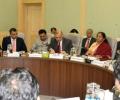
At a pre-Budget meeting, the FM was asked to ensure that NBFCs come out of the liquidity crisis they are facing with the help of RBI. They also spoke about the futility of trying to achieve a 3 per cent fiscal deficit target over the medium term.

Even with the possible expenditure roll-overs and off-budget financing, the fiscal deficit target will not be met. The FRBM Act, after its amendment in 2018, allows a fiscal deficit slippage of not more than 0.5 per cent for any given year, provided there are justifications. These justifications include war, national security, severe collapse in the agriculture sector, a major natural calamity, big structural economic reforms, or the decline in real output growth of a quarter by at least 3 percentage points below its average of the previous four quarters.
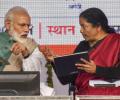
In the 2020-21 Budget, the prime minister and the finance minister are keen to stamp their narrative, after various rollbacks following the previous Budget, said top government sources. Besides the scheduled meetings, the sources said, the Prime Minister's Office is expected to hold several meetings with top secretaries and officials on various ongoing schemes, their performance and also how some of them could be tweaked for better results.

Long-term capital gains tax may be scrapped and the burden of dividend distribution tax could perhaps be shifted from companies to shareholders. Also, the Budget could provide income tax relief for the salaried classes, while proposing tax sops for small, medium and micro enterprises.

Sources said the rural development ministry has sought an additional Rs 20,000 crore for MGNREGA for 2019-20 over and above the budgeted Rs 60,000 crore for 2019-20. Though, all of the PM-KISAN savings may not be transferred to fund MNGREGA's extra needs, sources said a part of this could be transferred.

'We expect a pick-up in the second half of the current fiscal. But before that, data is likely to show a further slowdown. The second quarter print is likely to be worse than the first quarter,' said a senior official.

The economy could grow at 6-6.5 per cent this fiscal year (2019-20 or FY20), said Chief Economic Advisor Krishnamurthy Subramanian, revising his earlier estimate of 7 per cent in the Economic Survey. In an interaction with Arup Roychoudhury, he said supply-side measures, including corporation tax cuts, will boost consumption and demand, and non-tax revenue may make up for shortfall in tax revenues.
Dissatisfaction with the state leadership, along with caste and sectarian factors and economic issues -- particularly those relating to jobs and rural distress cost the BJP.

Sajjid Chenoy, India economist at JP Morgan is the new part-time member.

Among possible new members, former chief economic advisor Arvind Virmani's name is doing the rounds.

NITI Aayog had been asking for Rs 7,500 crore for three years to set up an AI framework.

For his first Budget in July 2014, Jaitley inherited a fiscal deficit target of 4.1 per cent of GDP. From 4.1 per cent, the fiscal deficit came down to 3.4 per cent by 2018-19, with two slippages from the budgeted targets, in 2017-18 and 2018-19, the former due to introduction of the GST, says Arup Roychoudhury.

Sources in the Fifteenth Finance Commission said that they will implement the provisions after the bill is enacted and the President makes a reference to it.

As the government plans to take sector-specific steps to tackle the slump, Finance minister Nirmala Sitharaman will soon hold talks with representatives from various sectors to get and take steps so that the confidence of those sectors can be restored.

Credit to priority sectors as well as small and medium industries will be discussed to find ways to accelerate economic growth.

An official said that people in the government were aware of the benefits as well as the drawbacks of issuing overseas sovereign bonds, and there will be consultations with all stakeholders.

With less than five months left for the report of the Fifteenth Finance Commission to be submitted, its chairman N K Singh said the report will have fiscal road map for states, depending on their current situation.
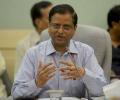
Owing to Finance Minister Nirmala Sitharaman being new to her role, a number of crucial announcements in the Budget bore Garg's imprint, especially the decision to borrow in overseas markets, reduce the fiscal deficit as a percentage of gross domestic product, and resort to off-Budget borrowing to meet that target, says Arup Roychoudury.

A government panel said policymakers and regulators should have an open mind regarding the introduction of an official digital currency in India.

The bonds will likely be simultaneously launched in major financial centres such as London, Singapore, Hong Kong, New York for a term of no less than 20 years.
